
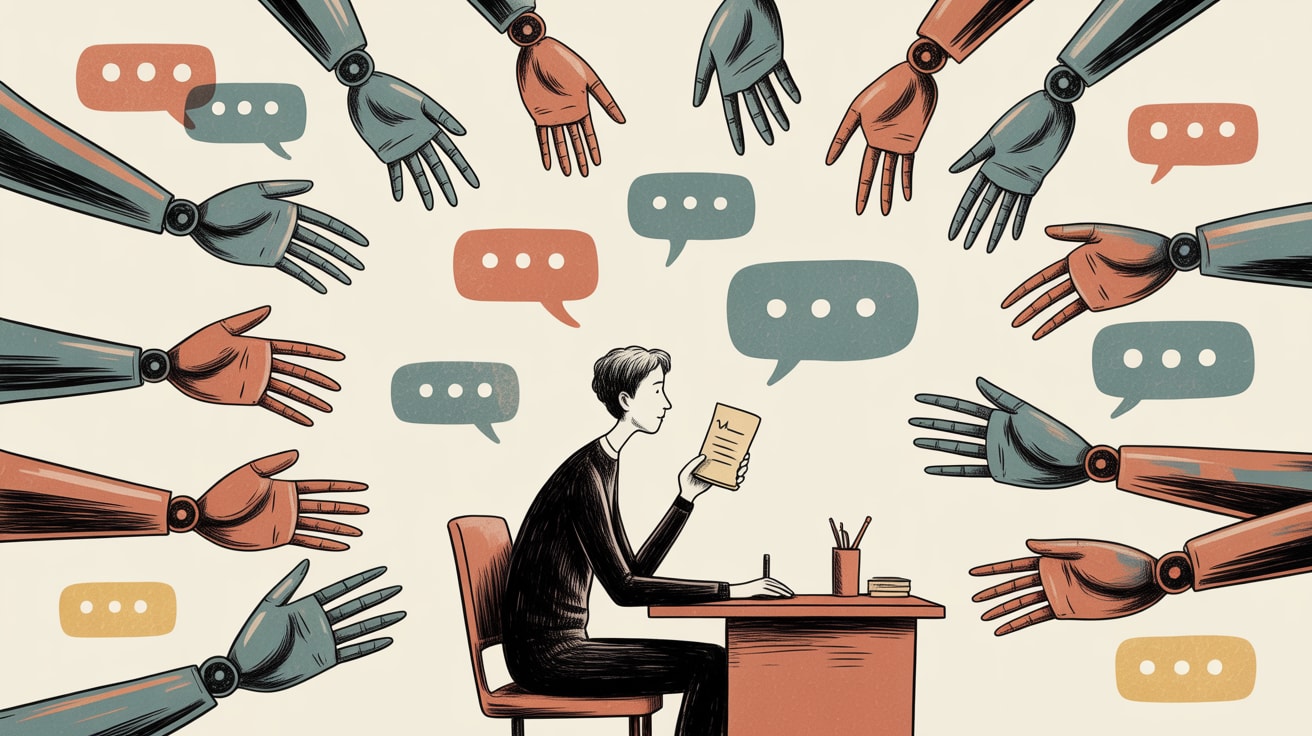
Most brands are shipping AI features nobody asked for. Here's what the data says about designing digital experiences that actually serve human intent.
Most product teams in Southeast Asia right now are sitting in a room asking some version of the same question: where do we put the AI? Smashing Magazine’s Vitaly Friedman has a blunt answer — stop. Most people don’t want more AI in their lives, at least not in the way the industry is currently building it.
That’s not a niche contrarian take. It’s a signal worth taking seriously, especially in a region where digital trust is hard-won and users are quick to abandon experiences that feel presumptuous.
The Feature Nobody Ordered Is Still Shipping
The pattern has become almost ritualistic: a product update lands, half the changelog is AI-powered suggestions, predictive inputs, or generative summaries — and engagement metrics either flatline or dip. The assumption driving this cycle is that AI capability equals user desire. It doesn’t.
Friedman’s analysis cuts to the real problem: most AI feature decisions are made from the supply side, not the demand side. Teams ask what can we build? rather than what friction is the user actually trying to escape? In markets like Indonesia or Vietnam, where mobile data costs still shape browsing behaviour and users maintain multiple apps for specific micro-tasks, shipping a bloated AI assistant into a utility app isn’t innovation — it’s interface pollution.
The diagnostic question isn’t “should we add AI?” It’s “what does our interaction data tell us users are repeatedly trying to do that we’re making harder than it needs to be?” That’s a data pipeline question as much as a design question.
Efficiency Ate the Experience, and Users Noticed
There’s a related tension that UX Collective contributor Zacharia C. articulates well: modern digital design optimised so hard for efficiency that it removed something users didn’t know they valued — the feeling of agency, of wandering, of a product that doesn’t predetermine your next step.
This matters for AI design specifically. When a recommendation engine decides what you’ll read, a chatbot anticipates your query before you’ve finished forming it, or a dashboard auto-summarises data you wanted to interpret yourself, the product has quietly shifted from tool to gatekeeper. Users feel that shift, even when they can’t name it.
The Southeast Asian context sharpens this. LINE’s success in Thailand, Grab’s super-app architecture across the region — these products work partly because they preserved meaningful user choice within structured flows. They didn’t remove decisions; they made the right decisions feel obvious without being forced. That’s a meaningful design distinction.
What “Human Touch” Actually Means in Interface Terms
The phrase gets used loosely, but there’s a precise definition worth building around: a human-touch interface is one where the user’s sense of authorship over the outcome remains intact. They feel like the agent, not the recipient.
Practically, this means a few things your design system should encode explicitly:
Transparency of logic. If AI is influencing what a user sees — ranked search results, personalised product feeds on Shopee or Lazada, dynamically generated email content — the user should have a legible way to understand why. Not a legal disclosure buried in settings, but a contextual signal in the moment. “Showing this because you browsed running shoes last week” is trusted. Opaque recommendation engines are not.
Reversibility. Every AI-assisted action should have a clear, low-cost undo. This is basic UX doctrine that gets quietly abandoned when teams are excited about automation. In practice, this means designing the failure state of your AI feature before you design the success state.
Opt-in escalation, not opt-out removal. Start users with the manual, human-feeling version of a flow. Offer AI assistance as an upgrade, not a default. The teams that get this right — and there aren’t many — see higher adoption of AI features precisely because users feel they chose them.
Measuring What You’re Actually Building
Here’s where the data architecture angle becomes relevant to a design conversation. Most teams can’t answer a simple question: of the users who encountered our AI feature last quarter, what percentage used it again within 30 days? They have aggregate engagement numbers, but not cohort-level behaviour by feature.
Without that pipeline, design decisions about AI features are made on launch-day enthusiasm rather than longitudinal evidence. You end up shipping v2 of a feature that v1 users quietly stopped using after week one.
The brands getting this right — regionally, think Tokopedia’s recommendation architecture or Sea Group’s cross-platform personalisation work — have invested in event-level data models that track feature-specific retention, not just session engagement. That’s what separates an AI feature that earns its place in the interface from one that’s quietly removed in the next design sprint.
Building a feedback loop between UX decisions and behavioural data isn’t glamorous work, but it’s the only way to make “human-centred” mean something beyond a design principle on a slide deck.
Key Takeaways
- Audit your last three AI feature releases against 30-day feature-specific retention data — if you can’t pull that report, fix the pipeline before shipping feature four.
- Design AI assistance as an opt-in escalation from manual flows, not a default replacement — this increases both trust and long-term adoption.
- Preserve user authorship by making AI logic transparent and all AI-assisted actions reversible; this is the operational definition of human-touch design.
The deeper question facing design teams across Southeast Asia isn’t whether to use AI — that ship has sailed. It’s whether the organisations building these products have the data infrastructure to know, honestly, whether their AI features are serving users or just serving the roadmap. That gap between capability and evidence is where the real design work happens.
At grzzly, we work with growth and marketing teams across Southeast Asia to connect UX decisions to the data pipelines that reveal whether those decisions are actually working — from event tracking architecture to the dashboards that surface feature-level user behaviour. If your team is shipping AI features and flying blind on whether they’re landing, that’s exactly the conversation we’re built for. Let’s talk
Sources

Written by
Chunky GrizzlyDesigning the foundational plumbing — data warehouses, lakehouse models, and ETL pipelines — that separates organisations with genuine intelligence from those drowning in dashboards.