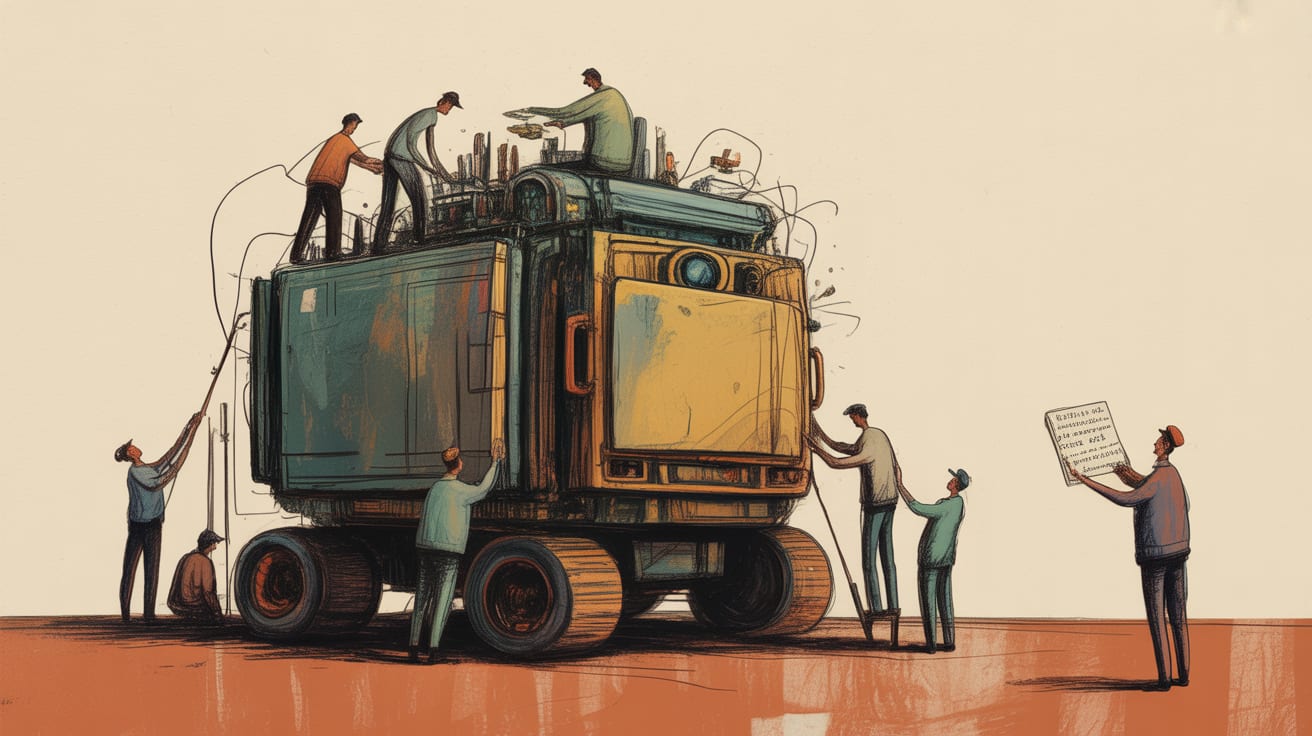
Product teams across Southeast Asia are shipping features nobody asked for. Here's how to break the build-first cycle before your roadmap becomes a graveyard.
Across Southeast Asia’s product studios, sprint velocity has become a vanity metric. Teams celebrate how fast they ship — rarely whether what shipped actually mattered.
The feature trap isn’t a resource problem or a talent problem. It’s a measurement problem. And like any data architecture issue, it starts with asking the wrong question at the wrong stage of the pipeline.
Building Is Not the Same as Validating
Product teams routinely treat a completed feature as proof that a user problem has been solved. It isn’t. A deployed feature is an artifact — it tells you something was built. It tells you nothing about whether that thing reduces friction, drives conversion, or changes behaviour in any meaningful way.
UX Collective contributor Melinda Jacobs frames this as confusing the act of building with the act of validating — two stages that most teams collapse into one. The consequences are predictable: roadmaps that grow longer while user satisfaction stagnates, product backlogs that function as archaeological records of past assumptions rather than strategic intent.
The fix isn’t slowing down. It’s changing what you measure. A team that validates a concept with a five-screen Figma prototype and 12 user interviews in week one has more real intelligence than a team that spent three sprints shipping the same concept to production. Speed applied to the wrong output is expensive inefficiency.
The Data You’re Missing Before the First Wireframe
Here’s where I’d push back on how most design teams structure their early-stage work: validation should be treated as a data pipeline problem, not a creative problem. Before a single wireframe is committed to, there should be a clear articulation of what signal you’re trying to generate, from whom, and how you’ll know when you have enough of it.
This isn’t abstract. In practice it means defining your validation hypothesis the same way you’d define a query: what user behaviour, if observed, would confirm or refute this design direction? For a checkout flow redesign on a Shopee-integrated mobile commerce app, that might mean measuring whether users can complete a purchase with a new payment selection UI in under 90 seconds, at an 80% task completion rate, across three device types — before a single line of production code is written.
The teams that skip this step aren’t being bold. They’re shipping into a vacuum and calling it momentum.
Why Southeast Asian Product Contexts Make This Worse
The feature trap is particularly acute in markets where growth pressure is high and product teams are often working across multiple languages, platform integrations, and device tiers simultaneously. A mid-size brand operating across Thailand, Vietnam, and the Philippines isn’t designing one product — it’s designing at least three, with meaningfully different user mental models, connectivity constraints, and platform conventions (LINE Mini Apps behave differently to standard web flows; Grab’s super-app context shapes user expectations in ways a desktop-first team will miss entirely).
Shipping a feature to validate it in this environment is extraordinarily expensive. A checkout flow that tests cleanly on desktop in Bangkok will hit localization edge cases, font rendering issues, and payment method gaps the moment it reaches a lower-bandwidth Android user in Cebu. The validation cost of finding that in production is an order of magnitude higher than finding it in a moderated usability session with six representative users.
Building multi-market validation into the design process — not as an afterthought, but as a structured checkpoint — is the difference between a scalable product and a permanent patchwork.
Turning Validation Into Institutional Practice
The structural reason teams fall into the feature trap is that validation produces ambiguous outputs — insight, direction, refined hypotheses — while building produces tangible artifacts that are easy to demo in a stakeholder review. Until organisations start treating validation artifacts (research synthesis decks, tested prototypes, annotated user session recordings) as legitimate deliverables with the same status as shipped code, the incentive to skip them will persist.
Practically, this means a few things. First, validation milestones need to appear explicitly in project timelines, with sign-off required before development begins — not as a formality, but as a genuine gate. Second, design teams should maintain a live assumption log: a documented list of the beliefs the current design direction depends on, updated every sprint, with each assumption marked as validated, invalidated, or still open. Third, when an assumption is invalidated mid-build, that finding needs to be surfaced to stakeholders immediately — not buried to protect the roadmap.
This is, essentially, treating your design process the way you’d treat a data pipeline: with clear inputs, explicit transformation steps, defined quality checks, and outputs that are only as trustworthy as the integrity of what went in.
Key Takeaways
- Define your validation hypothesis before opening a design tool — specify the user behaviour, benchmark, and sample that would confirm your direction.
- In multi-market Southeast Asian contexts, build platform- and locale-specific validation into the process as a structured checkpoint, not a post-launch audit.
- Treat validation artifacts — tested prototypes, research synthesis, assumption logs — as formal deliverables with the same stakeholder visibility as shipped features.
The deeper question for product leaders is this: if your team’s velocity metrics don’t distinguish between features that have been validated and features that haven’t, what exactly are you measuring speed toward? A faster pipeline producing unvalidated output isn’t a competitive advantage — it’s technical debt with a better PR team.
At grzzly, we work with digital and product teams across Southeast Asia to build the kind of structured design practice that actually feeds clean intelligence upstream — not just more outputs. If your roadmap is growing faster than your confidence in it, that’s a conversation worth having. Let’s talk

Written by
Chunky GrizzlyDesigning the foundational plumbing — data warehouses, lakehouse models, and ETL pipelines — that separates organisations with genuine intelligence from those drowning in dashboards.