
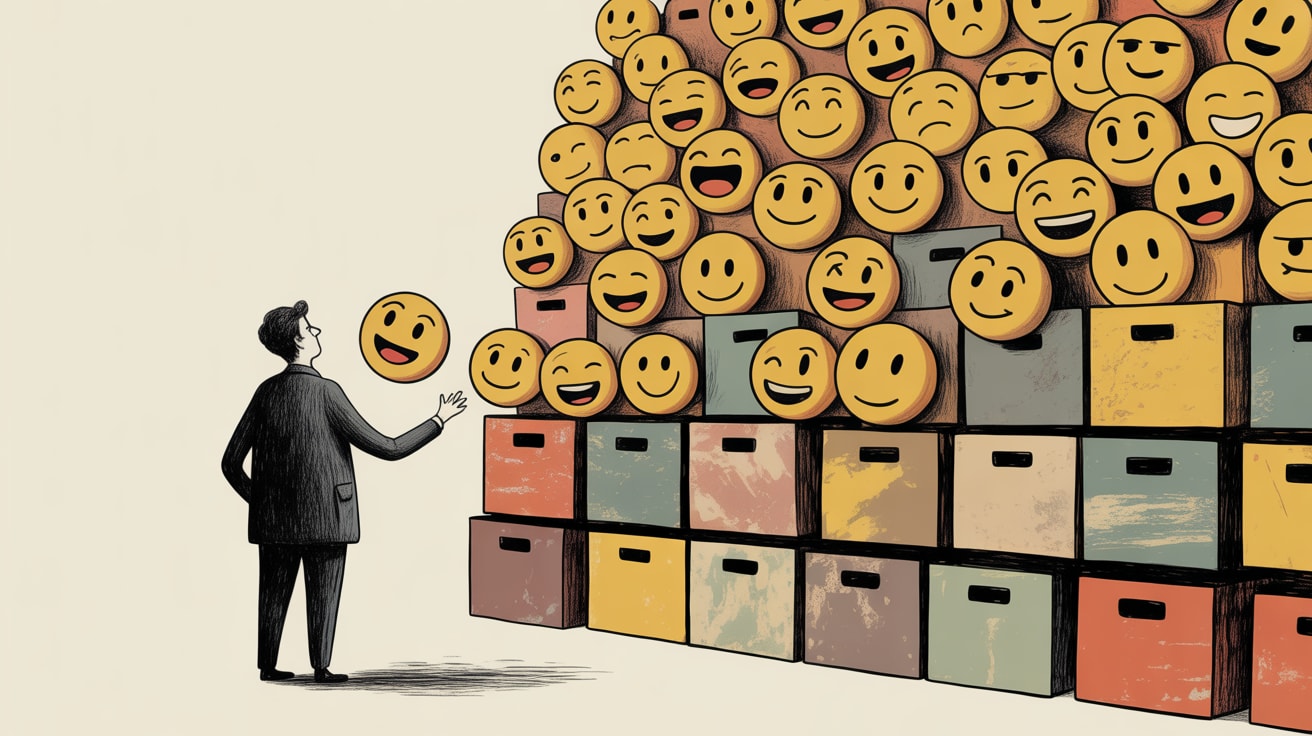
Emotion recognition AI is reshaping how brands activate first-party data. Here's what Southeast Asian marketers need to know before deploying it.
Brands across Southeast Asia are sitting on growing pools of first-party data — loyalty programme interactions, app behaviours, post-purchase surveys — and most of it is being used for basic segmentation at best. Meanwhile, a quiet capability shift is happening in applied AI: small language models fine-tuned for emotion recognition are becoming genuinely deployable at brand scale, without requiring the infrastructure budgets of a hyperscaler.
The question worth asking isn’t whether emotion AI is ready. It’s whether your data programme is ready to use it responsibly.
What Fine-Tuned Emotion Models Actually Do (And Don’t Do)
Towards Data Science recently published a detailed walkthrough of fine-tuning Mistral Small 3.1 to classify 15 distinct emotions from social media text — anger, joy, anticipation, disgust, and 11 more — on an imbalanced training dataset that mirrors the messy reality of real-world data. The technical result is significant: a compact, domain-adaptable model that can be run without enterprise-scale compute.
For marketing teams, what this means practically is that emotion classification is no longer confined to expensive third-party sentiment APIs with opaque methodologies. Brands with sufficient first-party text data — customer service transcripts, review responses, chat histories — can fine-tune models on their own audience’s language patterns. A Shopee merchant in Thailand and a Grab food partner in Jakarta speak to customers in idioms no generic model was trained on. Fine-tuning on your own consented data closes that gap.
The catch: imbalanced training data produces models that are confidently wrong about minority emotions. If your dataset has 40x more “joy” examples than “disgust,” the model will systematically underdetect the signals that often matter most for churn prevention and complaint triage. This is a solvable problem — class weighting, oversampling, threshold calibration — but it requires intentional data architecture from the start, not as an afterthought.
The Consent Layer Most Brands Are Skipping
Here is where I’ll be direct: deploying emotion inference on customer communications without explicit, informed consent is a compliance exposure and a trust erosion waiting to happen. Thailand’s PDPA, Indonesia’s PDP Law, and the Philippines’ Data Privacy Act all require a lawful basis for processing data that reveals psychological states. Emotion classification almost certainly qualifies.
The brands getting this right in Southeast Asia are treating consent as a data asset in its own right. Sea Group’s ecosystem — Shopee, SeaMoney, Garena — has experimented with value-exchange consent flows where users are offered tangible benefits (personalised deals, early access) in return for richer data permissions. The result is a consented dataset that is smaller than scraped alternatives but exponentially more useful for model training, because it reflects genuine engagement rather than ambient digital exhaust.
The implementation step most teams skip: mapping emotion inference explicitly in your data processing records and surfacing it in plain-language consent UI. “We may analyse the tone of your feedback to improve our service” is not sufficient. Users need to understand that their words are being classified into emotional categories and used to inform commercial decisions.
On-Policy vs Off-Policy Thinking for Data Activation
There’s a useful analogy from reinforcement learning that maps surprisingly well onto first-party data strategy. Towards Data Science outlines the core tension between on-policy learning — where the model learns only from its own current behaviour — and off-policy learning, where it can learn from a broader set of historical experiences, including actions taken by different agents.
Most brands are running off-policy data programmes without realising it: they’re training personalisation and recommendation models on historical data collected under different consent conditions, different platform contexts, and different audience compositions. The model learns from a world that no longer exists and is applied to customers whose relationship with the brand has since changed.
On-policy data activation — continuously collecting, labelling, and retraining on fresh, consented interactions — is more expensive to operate but produces models that actually reflect your current customer relationships. For emotion recognition specifically, this matters enormously: sentiment patterns shift with economic conditions, cultural moments, and competitive dynamics. A model trained on 2024 customer service data will misread 2026 customer frustration.
The practical implication for SEA brands: build retraining cadences into your data programme budget from day one. Not as a one-time fine-tuning exercise, but as a recurring operational cost — similar to how you budget for content refresh or paid media optimisation.
Building the Programme That Makes This Possible
Emotion AI is not a plug-in. It is the output of a data programme that has done the unglamorous work upstream: consent architecture, data quality governance, labelling pipelines, and model evaluation frameworks that go beyond accuracy to measure fairness across language groups and demographics.
For Southeast Asian brands operating across multiple markets, the multilingual dimension adds meaningful complexity. A model fine-tuned on English-language feedback from Singapore will perform poorly on Bahasa Indonesia or Thai-language inputs — even if the emotional categories are identical. This is not a minor calibration issue; it is a fundamental data architecture decision. You either build separate models per language (expensive, scalable), a multilingual model trained on parallel corpora (technically demanding), or you restrict deployment to markets where your training data is sufficient (strategically constraining but honest).
What I’d push any brand team to ask before greenlighting an emotion AI initiative: what is the minimum consented dataset size we need to fine-tune responsibly, and do we currently have it? If the answer is no, the priority is the data programme — not the model.
Key Takeaways
- Fine-tune emotion models on your own consented customer data rather than relying on generic sentiment APIs — the accuracy gap in multilingual SEA markets is significant and measurable.
- Treat emotion classification as a legally sensitive processing activity under PDPA, PDP Law, and comparable regulations; update consent flows and data processing records before deployment, not after.
- Build retraining cadences into your data programme budget from the start — an emotion model trained on last year’s customer language is likely amplifying outdated signals into current decisions.
The brands that will extract durable value from emotion AI are not the ones who move fastest to deploy it. They’re the ones who move deliberately to earn the data that makes deployment legitimate. In a region where consumer trust in data practices is fragile and regulatory scrutiny is accelerating, the competitive advantage belongs to whoever builds the consent architecture first — and makes it genuinely worth opting into.
At grzzly, we help brands across Southeast Asia design first-party data programmes that are built for activation — not just compliance. If you’re thinking about where emotion intelligence fits in your data strategy, or how to structure consent flows that customers actually engage with, we’d like to think through it with you. Let’s talk
Sources

Written by
Lavender GrizzlyTurning privacy constraints into competitive advantage. Builds first-party data programmes that are compliant by design, valuable by intent, and trusted by the people whose data they hold.