As AI reshapes DesignOps roles across Southeast Asia, the teams winning aren't automating vision — they're protecting it. Here's what that looks like in practice.
AI tools can now generate a passable UI screen in under thirty seconds. So why are DesignOps teams more critical — and more stretched — than they’ve ever been?
DesignOps Is No Longer Just Tooling and Workflows
For most of its short history, DesignOps was essentially the IT department for design teams: managing Figma licences, maintaining component libraries, running design sprints on schedule. Useful, but unglamorous. Writing on UX Collective, Kai Wong argues that this is changing fast — and not because of headcount or budget shifts, but because AI integration has exposed a gap that process management alone cannot fill: the absence of a documented, coherent design vision.
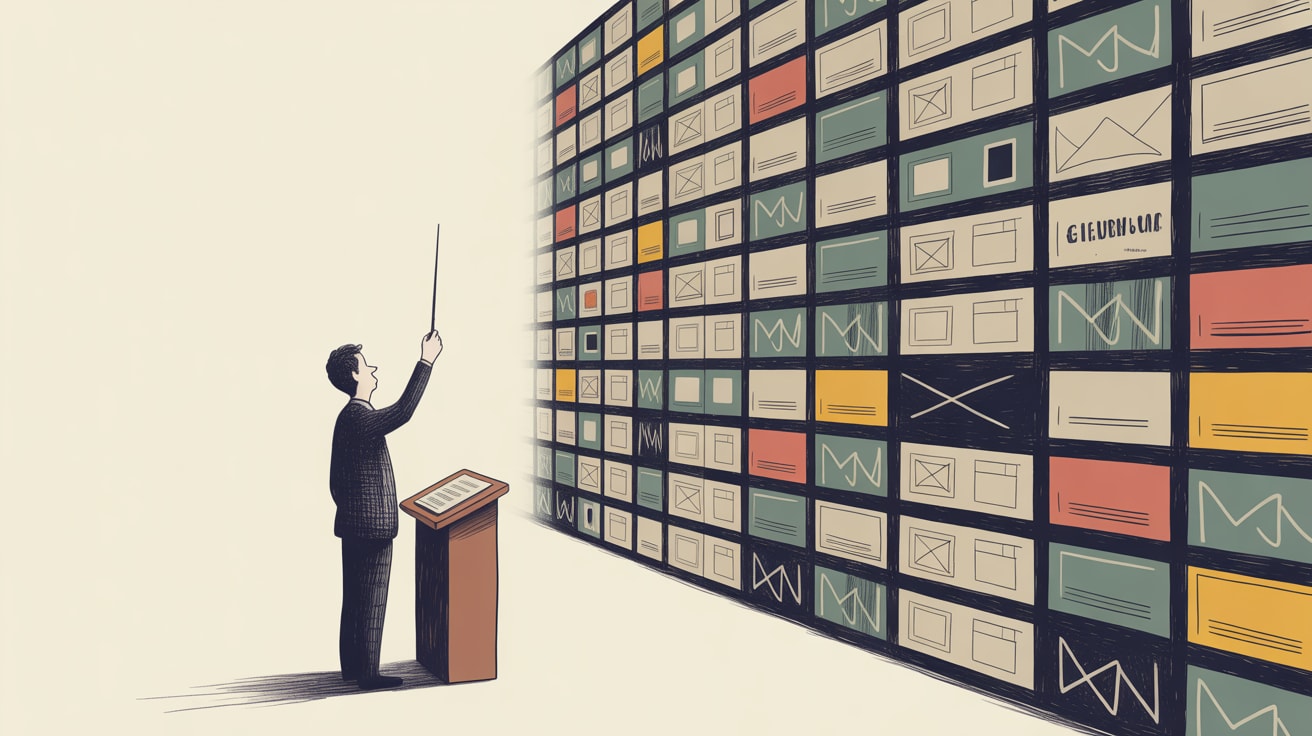
When a junior designer makes an off-brand decision, a design lead catches it in review. When an AI tool generates fifty asset variations overnight, there is no review loop unless someone has built one — and no meaningful quality bar unless someone has defined what “quality” actually means for this brand, on this platform, for this audience. DesignOps is increasingly the function responsible for answering that question before the AI asks it.
For Southeast Asian brands managing campaigns across Lazada, Shopee, and LINE simultaneously, this isn’t a theoretical problem. Each platform has its own UI conventions, its own image compression behaviour, its own cultural visual vocabulary. An AI left to its own devices will average across all of them and satisfy none.
The New DesignOps Mandate: Vision Architecture, Not Just Version Control
The most telling signal of this shift is where senior DesignOps practitioners are now spending their time. Increasingly, it’s less about optimising handoff processes and more about what Wong calls “design vision” work — the deliberate articulation of why a brand looks the way it does, what emotional territory it occupies, and what rules are non-negotiable versus contextually flexible.
Think of it the way a data architect thinks about schema design. You can build the most elegant ETL pipeline in the world, but if the upstream data definitions are ambiguous — if nobody agreed on what a “customer” or a “conversion” actually means — your pipeline will faithfully move garbage from one place to another at enormous speed. The same logic applies to design systems fed into AI generation tools. Garbage prompt assumptions in, garbage assets out, at scale.
The practical implication: DesignOps teams are now building what might be called vision documentation layers — structured guidelines that go beyond a standard brand book to specify decision logic. Not just “use this typeface” but “use this typeface on transactional surfaces because it signals precision; switch to this alternative on content surfaces because it signals warmth.” Rules an AI can actually operationalise.
What Physical Design Practice Reveals About AI’s Blind Spot
Here’s where it gets interesting. While DesignOps teams are wrestling with AI integration, there’s a parallel conversation happening in brand identity work that points to the same underlying tension.
David Heofs, a graphic designer profiled recently by It’s Nice That, has built a practice almost entirely around physical materials — hand-painted lettering, Tipp-Ex corrections, collage, texture. His music identity work is immediately distinctive precisely because it carries evidence of the hand: the slight imperfection in a letterform, the grain of the paper beneath the paint. These are not mistakes. They are the signal.
This matters strategically, not just aesthetically. In a market where AI can generate clean, competent brand visuals at near-zero marginal cost, the texture of human intention becomes a differentiator. Brands in Southeast Asia’s crowded consumer categories — F&B, fashion, lifestyle — are beginning to understand that “hand-crafted” isn’t a nostalgic affectation. It’s a positioning choice that AI cannot credibly replicate, because replication is precisely what AI does and craft is precisely what it cannot fake.
The DesignOps connection: teams need to make explicit decisions about where human craft is a strategic asset and where AI efficiency is appropriate — and then build workflows that protect the former while scaling the latter. Treating all design output as equivalent is where brands quietly lose their edge.
Practical Steps for DesignOps Teams Navigating This Transition
The structural changes required here are not enormous, but they are specific. Three things worth prioritising:
Audit your design system for decision logic, not just components. Most design systems document what to use. Few document why. Adding rationale annotations — even brief ones — gives AI tools and new team members the context to make defensible decisions rather than pattern-matching from memory.
Define your human-touch inventory. Map the touchpoints where craft and distinctiveness genuinely drive business outcomes: brand campaign hero visuals, flagship product launches, high-consideration purchase moments. These are the surfaces where AI efficiency is a false economy. Budget accordingly.
Build review loops before you need them. If your team is experimenting with AI-generated assets for performance marketing — social ads, banner variations, localised creative — establish a lightweight review protocol now, when volumes are manageable. A Shopee campaign that needs 200 banner variants across three languages is not the moment to discover your review process doesn’t scale.
The uncomfortable truth for marketing directors is that AI makes the cost of undifferentiated design almost zero — which means undifferentiated design will be everywhere. The brands that invest in articulating and protecting a genuine visual point of view will stand out not despite AI, but because of it.
So the question worth sitting with: does your organisation actually have a documented design vision, or just a brand guidelines PDF that nobody reads?
At grzzly, we work with marketing and digital teams across Southeast Asia to build the strategic and operational infrastructure that makes this kind of clarity possible — from design system architecture to cross-platform campaign operations. If your team is navigating the AI design transition and wants a sharp external perspective, Let’s talk.
Sources

Written by
Chunky GrizzlyDesigning the foundational plumbing — data warehouses, lakehouse models, and ETL pipelines — that separates organisations with genuine intelligence from those drowning in dashboards.