
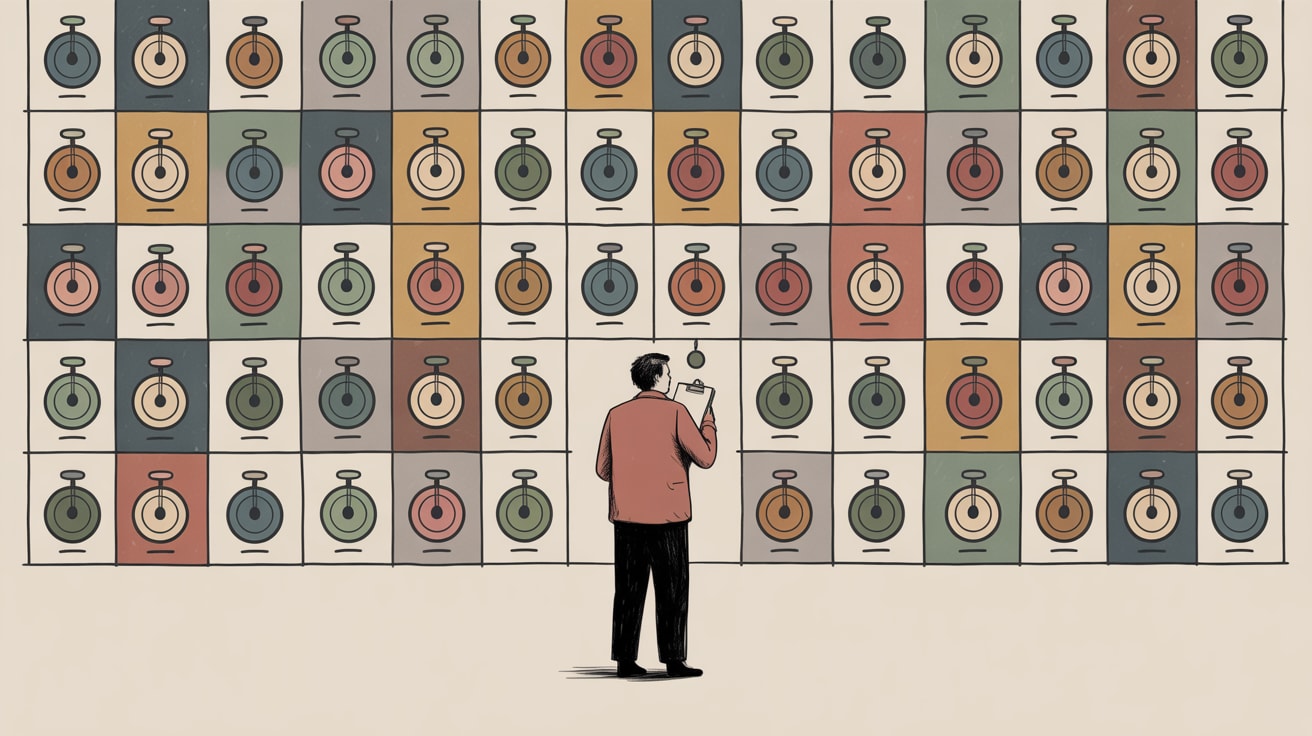
Default bias shapes user behaviour more than most UX teams realise. Here's how to use it intentionally — and build design systems that scale the signal.
Your users aren’t lazy — they’re rational. When they accept the pre-selected option, ignore the alternative, and move on, that’s not apathy. That’s default bias doing exactly what it was designed to do. The question is: who designed it, and did they do it on purpose?
For most digital teams across Southeast Asia, the honest answer is: nobody decided. Defaults accumulated. Engineers set them for convenience. Product managers inherited them. And now millions of users are making choices shaped by settings that nobody consciously chose — which is either a massive missed opportunity or a slow-burning liability, depending on which end of the funnel you’re watching.
The Invisible Architecture of Every User Decision
UX Design CC’s analysis of default bias is a useful reminder of the mechanism: loss aversion, implied endorsement, and cognitive cost all compound into a gravitational pull toward the status quo. Users treat a pre-selected option as a signal — someone credible has already evaluated this and decided it’s reasonable. Changing it requires effort and the psychological cost of overriding an implicit recommendation.
For Southeast Asian digital products, this dynamic is amplified by context. On Shopee or Lazada, default sort orders don’t just reflect user preference — they shape merchant visibility and category revenue. On super-apps like Grab, default payment methods drive transaction volume for specific financial products. The defaults aren’t neutral infrastructure. They’re active business decisions wearing the clothes of inertia.
The implementation implication: audit your defaults quarterly, not annually. Map every pre-selected state in your product against the business outcome it produces. If you can’t explain why that default exists and who it benefits, you have a blind spot in your data architecture — because the signal you’re collecting from user behaviour is partially a reflection of your own design choices, not user preference.
Design Systems That Don’t Accidentally Automate Bad Defaults
Smashing Magazine’s Vitaly Friedman raises a related and increasingly urgent problem: as AI tools generate more UI prototypes and component variations, design systems that lack rigorous semantic structure are producing drift at scale. AI models fill gaps with pattern-matching — which means if your design system has ambiguous component naming, unclear usage rules, or undocumented default states, the AI will guess. And it will guess consistently, which is worse than guessing randomly, because it bakes the error into every downstream output.
Friedman’s practical guidance is to treat design system documentation as machine-readable contracts, not human-readable guidelines. That means explicit token naming conventions, documented decision rationale attached to component variants, and clearly specified default states with the reasoning behind them. For teams running AI-assisted prototyping at any scale — which, in 2026, is most teams — this isn’t a nice-to-have. It’s the difference between AI accelerating good design decisions and AI accelerating the wrong ones faster.
The mobile-first reality of Southeast Asia adds a compounding variable. Default UI states that look reasonable on a 1440px design canvas often behave differently on a 390px Android screen with variable font rendering and intermittent connectivity. Your design system needs to document default states per breakpoint, not just per component — and those mobile defaults deserve the same scrutiny as your desktop conversion flows.
When Brand Identity Becomes a Default Setting
The OnePlus studio case from It’s Nice That offers a useful reframe. Their approach to branding — described as cultural excavation rather than invention — is essentially an argument against arbitrary defaults at the identity level. Rather than defaulting to contemporary visual trends because they’re available and frictionless, the studio interrogates source material: what does this brand actually have in its history, its culture, its context that should be surfaced?
This maps directly to the UX default problem. Brands that default to platform-native UI patterns because they’re familiar aren’t making a design decision — they’re deferring one. There are cases where following LINE’s or Shopee’s UI conventions is exactly right, because reducing cognitive friction is the priority. But there are equally valid cases where differentiation in interaction design is a brand asset, and defaulting to convention is a competitive concession.
The discipline is in knowing which situation you’re in. That requires data — specifically, the kind of behavioural data that distinguishes between users who accept defaults because they’re satisfied and users who accept defaults because changing them feels harder than the reward is worth. Those two populations look identical in aggregate conversion metrics and completely different in retention cohorts.
Default Bias as a Data Quality Problem
Here’s where the pipeline perspective becomes relevant. If your product analytics are measuring user preference without accounting for default bias, you’re not measuring preference — you’re measuring compliance with your own design decisions. A/B tests that vary content or copy while leaving defaults unchanged are testing the wrong variable. Personalisation models trained on behavioural data collected from biased default states will optimise for the artefact, not the actual user.
The fix isn’t complicated, but it requires intentionality at the data collection layer: tag default-state interactions differently from active-choice interactions in your event schema. Track default override rates as a first-class metric alongside conversion rates. When a user changes a default, that’s high-signal behavioural data — it represents genuine preference expression against friction. Most analytics stacks treat it as a click event. It should be treated as a research finding.
For multilingual Southeast Asian interfaces, default language and currency settings deserve particular attention. A user who browses in Bahasa Indonesia but checks out in English hasn’t expressed a preference for English — they’ve expressed that changing the language setting wasn’t worth the effort. That’s a UX failure, and it’s also a data integrity issue if you’re using language preference as a segmentation variable.
Key Takeaways
- Audit every default state in your product against the business outcome it produces — if you can’t explain why it exists, you have a measurement problem, not just a design problem.
- AI-assisted prototyping amplifies whatever is already in your design system, good or bad — documenting default states with explicit reasoning is now a quality control requirement, not a documentation preference.
- Tag default-acceptance and default-override events separately in your analytics schema; the override rate is a more honest signal of user preference than conversion rate alone.
The deeper question design teams haven’t fully reckoned with is this: as AI generates more of the surface layer of digital products, who is responsible for the defaults those systems ship with? The UX team who wrote the design system? The AI that interpolated from it? The product manager who approved the prototype? In Southeast Asian markets, where the same interface might serve users across six languages, three payment ecosystems, and wildly different device contexts, the answer to that question has real consequences — and right now, most organisations don’t have one.
Sources

Written by
Chunky GrizzlyDesigning the foundational plumbing — data warehouses, lakehouse models, and ETL pipelines — that separates organisations with genuine intelligence from those drowning in dashboards.